

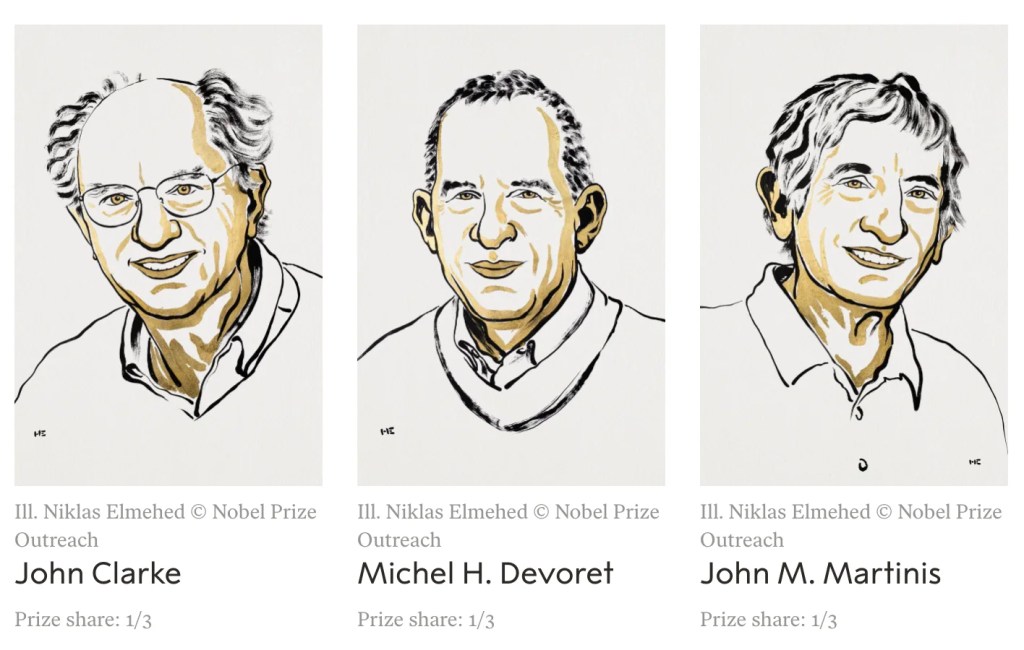
The 2025 Nobel Prize for Quantum Physics has been awarded! It goes to John Clarke, Michel H. Devoret, and John M. Martinis — three scientists who proved that the peculiar rules of quantum physics can show up in something big enough to see and touch. These scientists didn’t just break the laws of physics, they found a whole new legal system! Scientists were able to reproduce quantum behavior in the physical world we live in and see everyday. These scientists who got the Nobel prize, were able to recreate Quantum behavior and they called it Quantum Tunneling in a physical electrical circuit, which is HUGE!
Classical/Macroscopic/Newtonian physics are the physics of objects that we observe in our life. Quantum Physics is the physics of really small objects like electrons, protons and neutrons, and it normally contradicts the rules that Issac Newton wrote centuries ago. Specifically, Newton says that objects have an exact position and exact velocities. On the other hand, Quantum physics, specifically Heisenburg’s Uncertainty Principle tells us that you cannot know both position and momentum exactly at the same time. For example, your phone wouldn’t exist without Quantum Physics, because the transistors, the tiny switches inside your phone, rely on quantum effects. A particle can be in two places at once, or even pass straight through a barrier which is called Quantum Tunneling.
This year’s Nobel Prize discovery was considered special because these scientists made quantum behavior appear in an ordinary electrical circuit using a device called a Josephson junction, which usually involves two superconductors separated by a thin barrier. At absolute zero, some materials lose all electrical resistance which is called superconductivity, and it’s actually the key to a Nobel discovery. At lower temperatures, their circuit showed the same kind of tunneling that usually only happens at the atomic level. In simpler terms, these scientists made a circuit act exactly like an atom. It’s like teaching your toaster to think it’s an atom! This was considered a huge leap in understanding how quantum effects can exist on a macroscopic, or visible scale.
This absolute breakthrough isn’t just considered science, or a discovery. It’s considered as the foundation of Quantum Computing, a field that could someday make computers a million times faster than the computers we work with today. Thanks to John Clarke, Michel H. Devoret, and John M. Martinis, we’re one step closer to understanding a whole new kind of technology — one where the strangeness of Quantum Physics becomes a part of our everyday lives.



 Eagle's Eye Newspaper